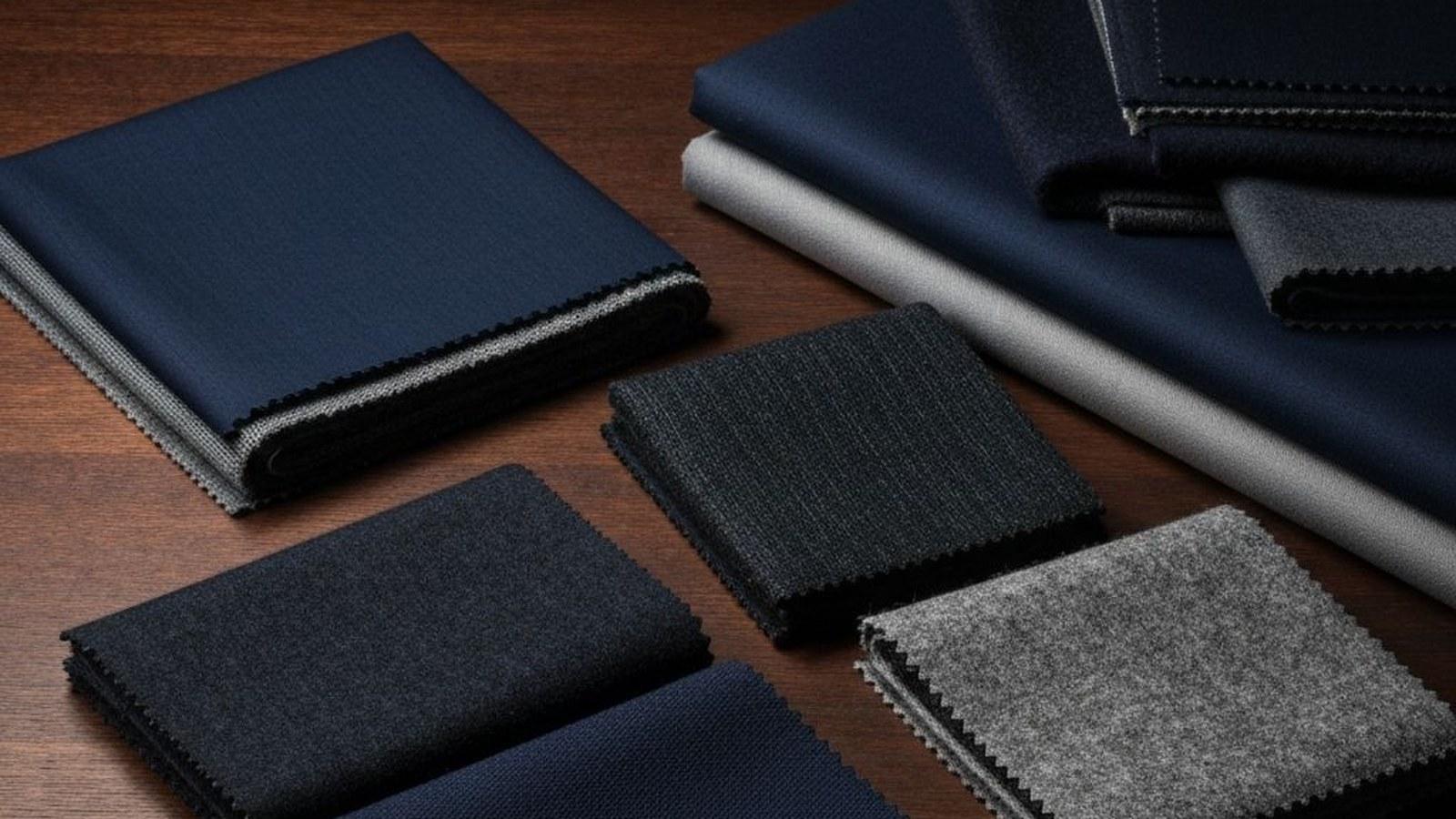
A suit only performs as well as the cloth it is cut from, and in Hong Kong the cloth has to survive a climate that most tailoring advice ignores. We have been cutting for this city since 1962, and the questions are always the same: will it be too hot, will it crease, is the expensive bunch worth it. Here is how we answer them.
Start with weight, not fibre
The most useful number on a cloth bun is the weight in grams per running metre. For Hong Kong, most of the suits we cut sit between 250g and 280g. That is heavy enough for the jacket to hang cleanly and the trousers to recover after a morning in a chair, light enough to walk from the MTR into an air-conditioned office without wilting.
Above 320g you are in winter cloth. It is beautiful and holds a sharp edge, but outdoors here it is unwearable most of the year. Below roughly 240g, cloth starts to behave like paper: it creases hard, the trouser line collapses by lunchtime, and the jacket has too little body to drape over the canvas. We keep the heavy end in the library anyway, because Hong Kong does have a short sharp winter and because clients travel to Shanghai in January or London in February. If this is your first commission, buy the 250–280g cloth. Add the heavier one later, once you know how you actually wear tailoring.
High-twist and fresco: cloth that expects to sweat
The yarn matters as much as the weight. High-twist worsted is spun tighter than usual, which gives the cloth a dry, springy hand; the fibres resist bending, so the suit sheds creases instead of holding them, and air moves through the weave rather than sitting against the skin. Fresco is the open, porous version of the same idea — visibly woven, slightly stiff at first, and about as comfortable as a tailored jacket gets in July.
Both have a cost. Fresco lacks the soft, liquid drape people picture when they hear the word bespoke, and it can feel scratchy against a thin shirt, so we usually cut it half-lined. High-twist cloth also presses to a drier finish, so the lapel roll is crisper and less romantic. For anyone moving between street heat and a cold office, that trade is usually worth making. Scabal and Holland & Sherry both keep good high-twist bunches, and they are the ones we reach for most often between May and September.
Wool, linen, cotton: what each actually does here
Wool is the default, and for good reason. Worsted wool — the smooth, tightly spun cloth from which nearly all business suits are cut — breathes, recovers from creasing and drapes without help. Reda and Vitale Barberis Canonico make worsteds that survive daily wear in this city; Ermenegildo Zegna and Loro Piana sit at the softer, more expensive end of the same family. Almost every suit we cut for a banker, a barrister or a groom is worsted wool.
Linen is the honest summer cloth. It is cool because the fibre is hollow and the weave is loose, and it creases because it has almost no elasticity — that is the fabric working, not failing. We cut linen for weddings, weekend jackets and holidays, and we warn clients that a pure linen trouser will bag at the knee by evening. A linen-wool or linen-silk blend keeps most of the coolness and holds its shape much better; for a first linen suit, that is what we recommend.
Cotton is the one people overestimate. A cotton suit photographs well and feels familiar, but cotton has poor recovery: it creases and stays creased, and a cotton jacket worn weekly looks tired quickly. It works for a casual suit you wear a few times a month, for odd trousers, and for travel. As a daily office suit in a humid city, it is a compromise. A cotton-wool blend behaves better, and seersucker — a puckered cotton weave that lifts off the skin — is genuinely useful in the worst of August.
What Super 150s to 180s actually means
The Super number describes the fineness of the wool fibre, not the quality of the cloth. A higher number means a finer yarn, a softer hand and more lustre, and it also means less abrasion resistance. Nothing about the number guarantees that the cloth was woven well, finished carefully or will last.
This is where fine cloth becomes a false economy. A Super 180s suit is lovely to touch and photographs beautifully, but worn twice a week it will shine at the seat and the elbows sooner than a 130s workhorse, and it cannot be pressed back. Finer cloth also asks more of the maker: it needs a lighter canvas, gentler tension and more hand work at the edges, so the making cost rises with the cloth. We will happily cut a 150s for a wedding. We will argue with you if it is going to be your only work suit.
Lining is half the suit in this climate
A jacket's lining is a windbreak. It helps the jacket slide on and off and protects the cloth from the inside, but a full synthetic lining traps heat across the whole back. For summer cloth we use a light cupro lining — Bemberg is the standard — and cut many jackets half-lined to the shoulder, leaving the back open behind the canvas. That single decision changes how a suit feels at 3pm more than any difference between two similar cloths.
Sleeves are always lined; an unlined sleeve wears through at the elbow. For the body, unlined is possible with a heavy enough cloth and a cleanly finished inside, but that is a connoisseur's choice, not a hot-weather shortcut. Ask what the lining weighs, not just its colour.
Where cloth meets canvas and finishing
Cloth and construction have to agree with each other. A floating canvas — the layer of horsehair and wool stitched inside the chest, never glued down — needs cloth with enough body to carry it. Put a very fine, very light cloth over a heavy canvas and the front ripples; put a stiff fresco over a soft canvas and the lapel looks flat. Matching the two is a judgement the cutter makes with the cloth in hand.
Finishing reacts to cloth as well. Chalk stripes and large checks have to be matched at every seam, which consumes more cloth and more cutting time; a cheap cloth cut to a bold check will show the mismatch at the shoulder. Cloth is also rested and shrunk before cutting, because a suit that shrinks after its first clean is a suit that was never really fitted.
What we ask in the fitting room
Before we open a bunch, we ask four things: how many days a week you will wear the suit, whether you are outdoors in the middle of the day, whether you travel by car or on foot, and whether this is your first or your fifth commission. The answers usually narrow the library down to a handful of cloths within a few minutes.
If you are unsure, come and feel the difference. The weight and the twist of a cloth are things you understand in your hand, not in an article. Browse the cloth library before you visit, read how a bespoke suit is made, and see the cut we build for men's bespoke suits and ladies' bespoke suits. Then book a fitting at our Tsim Sha Tsui atelier and we will put the bunches on the table.