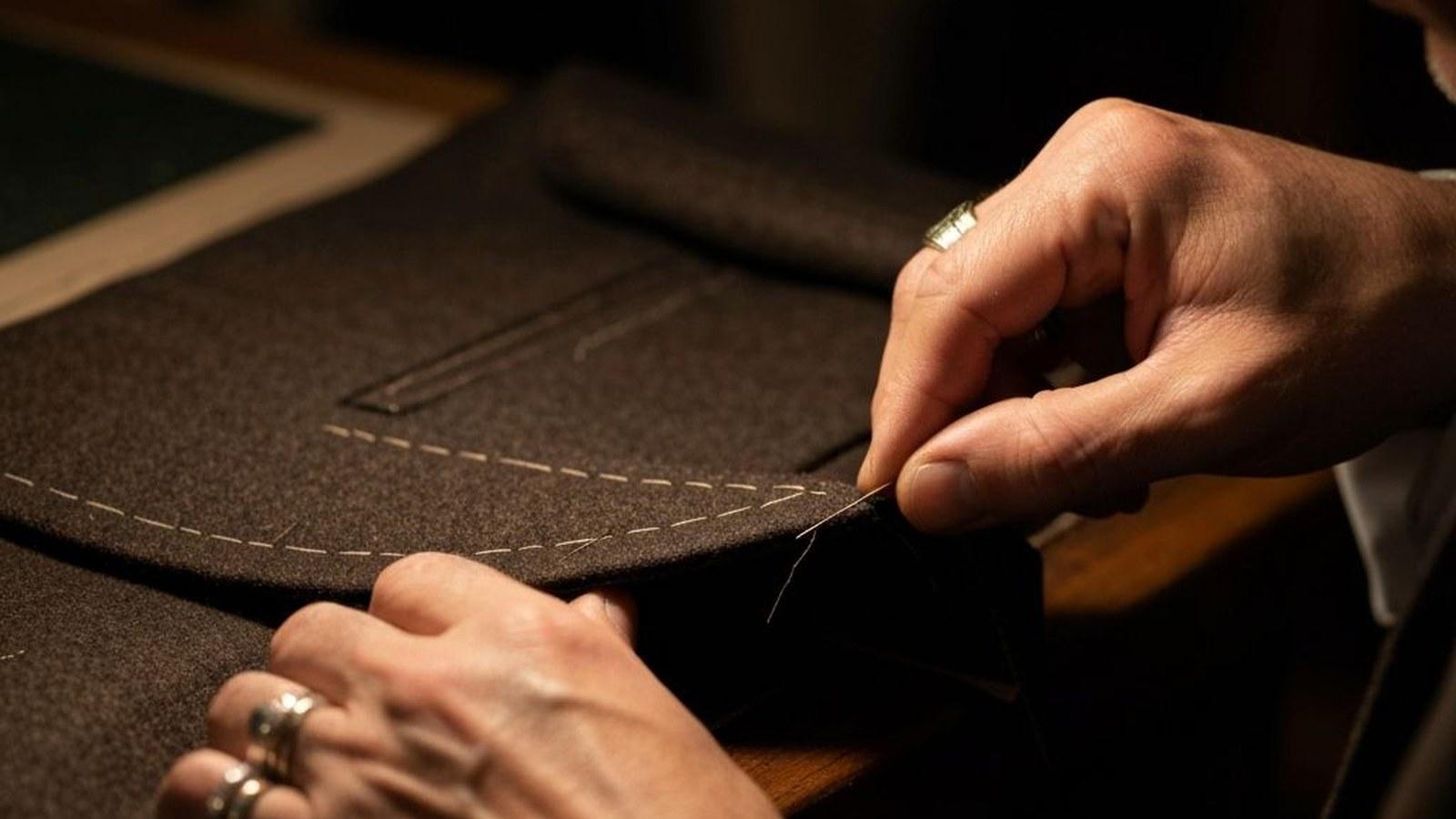
Every tailoring shop in Hong Kong will tell you it does "custom suits". The phrase covers three processes that differ in pattern, canvas, number of fittings and delivery time, and the difference shows up two years later, not on the hanger. Here is what actually separates ready-to-wear, made-to-measure and true bespoke, and how to find out which one you are being sold.
Three processes, not three prices
Ready-to-wear is cut in a factory to a standard size chart. The shop can shorten a sleeve or take in a waistband, but the shoulder line and the collar are fixed. If the shoulder does not sit on your shoulder, no alteration will rescue it.
Made-to-measure starts from an existing block pattern. Your measurements are used to grade that block up or down and adjust a few points, then the garment is cut and sent to a workshop. You will usually get one fitting, sometimes none.
True bespoke starts from blank paper. A cutter draws a pattern for you alone, by hand, and that pattern is kept on file so the next commission begins from a known shape instead of starting again.
The pattern is where the difference begins
Two men can both wear a size 48 and need completely different patterns: one shoulder slopes, one hip sits higher, one stands with the chest forward. Made-to-measure can lengthen, shorten and let out. It cannot redraw the slope of the shoulder or the curve of the back.
Bespoke redraws those lines from your own shoulder point, chest width and back curve. This is why a first baste fitting often looks wrong to the client. It is supposed to: the garment is still an argument about your posture, not a finished suit.
Canvas: the part you can feel with your hand
Inside the front of every suit jacket there is a layer that decides whether the chest holds its shape after three years or collapses. The cheap method fuses an interlining to the cloth with heat and glue; wear it hard and it bubbles. True bespoke uses a floating canvas, held in place with stitches so it moves with the body and gradually takes the shape of the wearer. Most made-to-measure is half-canvassed: canvas through the chest, fused below.
Half canvas is not a con. It is a fair trade between price and process. But you are entitled to ask, in plain words, "is the front full canvas, half canvas or fused?" A good shop answers without flinching.
Fittings: one against three
Bespoke means at least two fittings, usually three. The first is the baste, held together with white stitching, used to correct shoulder slope, collar and waist. The second shows how the cloth actually hangs. The third is for finishing.
Made-to-measure normally means one fitting, and what gets adjusted is length and a little ease. A fitting is not an inspection. It is a revision, and the first one is meant to produce a list of changes.
Time: three to four weeks, or six to eight
Made-to-measure takes three to four weeks. True bespoke takes six to eight, and somewhere between fifty and seventy hours of hand work go into a jacket and trousers. The extra weeks are not slowness. They are cutting a paper pattern, making a baste, unpicking it and sewing it again.
So when a shop advertises "full bespoke, ready in two weeks", the useful question is how many fittings you will actually get.
Thirty-odd numbers
Proper measuring is not three numbers. Shoulder slope, the height of each shoulder relative to the other, the curve of the back, the length of the neck, whether you stand forward or back on your heels: all of it goes into the pattern. We take more than thirty measurements per client, note posture and asymmetry, and keep the profile on file so a repeat order starts from your own shape rather than from scratch.
This is also why a suit can feel correct in the shop and wrong after a week. Cloth follows posture. If nobody wrote down your posture, nobody cut for it.
How to tell what a shop is really selling
- Ask about the pattern. "Is there a paper pattern in my name? Will you use it again next time?"
- Ask about fittings. "How many, and is the first one a baste?"
- Ask about canvas. "Full canvas, half canvas or fused?"
- Ask who cuts. "Who cuts the cloth, and is it cut here or at a workshop?"
- Read the delivery time. Three weeks and eight weeks are usually a description of the process, not a promise about speed.
None of this means every shop must sell the most expensive option. A good one will tell you which process suits this particular garment, rather than calling everything bespoke.
Hong Kong weather changes the answer
For a suit worn to work through a Hong Kong summer, cloth around 250 to 280 grams is sturdy enough and still breathes; for winter, or for a cold office, 320 grams and up hangs with more weight. Made-to-measure suits the first suit, the second suit, the one that gets worn hard and replaced. Bespoke suits a wedding, a photograph you will keep, or a man who already knows what he wants.
Choosing, and what to ask first
If you are commissioning your first suit, start with one honest question: what will this shop do that a good alterations tailor cannot? The answer should mention a pattern, a canvas and a fitting, in that order.
You can read the full sequence on our tailoring process page, or look at how we cut a bespoke suit. When you are ready, book a fitting at our Tsim Sha Tsui atelier. We will tell you which of the three you actually need, including when the answer is the cheaper one.