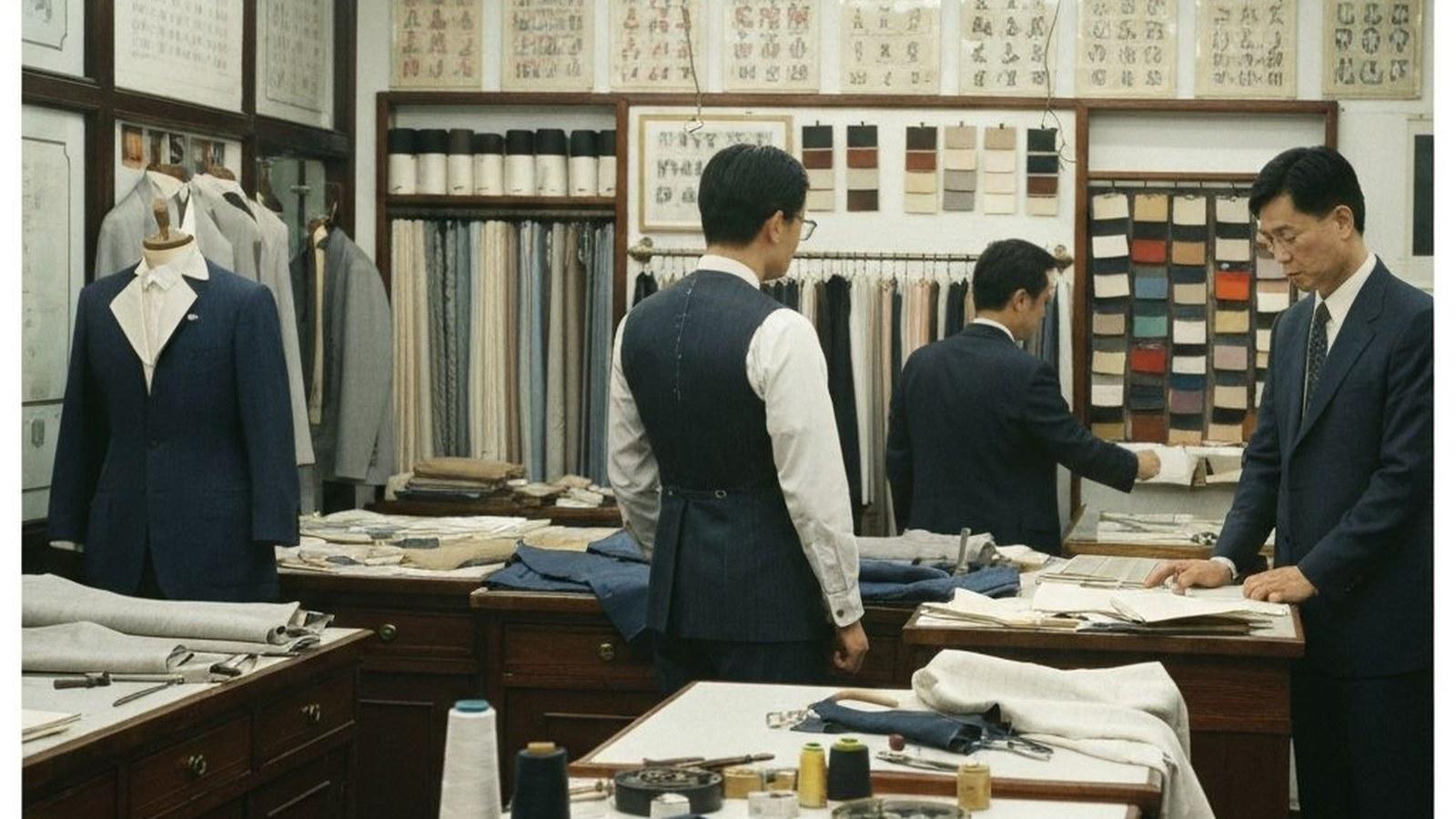
A wedding suit is worn once and photographed for decades. That single fact explains most of the difference between renting, buying off the rack and commissioning a suit, and it is why we ask a groom what he wants the photographs to look like before we ask what he wants to spend.
Why a groom commissions rather than rents
A rental jacket is cut for an average body and then pinned to look like yours. The waist is taken in with a strap at the back, the sleeves are shortened without moving the buttons, and the shoulders stay where they were made. It reads fine at eight in the morning. By the third hour, with a jacket that has been dry-cleaned between hires and a chest panel that is usually glued rather than stitched, it starts to look like what it is: someone else's suit.
A commissioned jacket begins as a paper pattern drawn to your measurements. We take more than thirty, and the ones that matter are not the chest and waist but the notes beside them: which shoulder sits lower, how far the neck pitches forward, whether you stand with your weight on one hip. Two shoulders are almost never level. A rental has no answer for that. A pattern does.
There is also the question of what you are actually buying. A rented suit is a hire fee for a garment that goes back on a rail. A commissioned suit is a jacket and trousers that will still fit at a friend's wedding in five years, and can be let out or taken in when your shape changes. Grooms who marry in December and attend four weddings the following year tend to notice this.
What the first fitting actually does
The first fitting is not a preview of your suit. It is a basted try-on, usually in a cotton mock-up or the shell of your cloth tacked loosely together, and it exists to settle balance before anything is cut properly. The tailor is looking at the collar, the shoulder line, the sleeve pitch and the back. He will ask you to stand naturally, then to walk, then to sit. Most of the work happens with chalk and pins, and most of it is about the parts of the jacket you never see in a mirror.
Expect it to look unfinished. It is meant to. If a first fitting looks like a finished suit, someone is showing you a garment rather than testing one.
The second fitting: cloth, line and proportion
By the second fitting the jacket is in your cloth with the canvas floating inside it, and the conversation changes from fit to line. This is where you decide whether the waist wants another centimetre, whether the lapel rolls where you expected, whether the trouser breaks once or not at all. Bring the shirt and shoes you plan to wear. A quarter-inch of shirt cuff showing is a decision, not an accident, and it is easier to judge with the real shirt on your back.
Bring your concerns too. If the jacket feels tight across the back when you reach forward, say so at this fitting. If the trousers sit differently when you sit down, say so. A tailor can move a button stance or square a shoulder now; after the buttonholes are cut, the options narrow sharply.
The final fitting, and the week after
The last fitting is about detail: buttonholes, pick stitching, the sleevehead, the hang of the finished trouser. Wear the suit for ten minutes, sit in it, put your hands in the pockets, take the jacket off and put it back on. Small adjustments at this stage are normal and usually take a few days. Then wear it around the flat for an hour before the wedding, not to break it in but to find out where it pulls.
Timing: six to eight weeks, and why the calendar matters
True bespoke at our atelier takes six to eight weeks from first measurement to collection, because it includes a basted fitting, a second fitting and hand-finishing. Made-to-measure takes three to four weeks: we adjust an existing block rather than cutting a new pattern, so there is usually one fitting instead of three.
Those numbers assume the cloth is in stock. They also assume you are in Hong Kong for the fittings. If you are marrying in October or November, the comfortable window is late July, not September. A wedding date does not move for a tailor's queue, and the worst conversations we have are with grooms who arrive four weeks out and want a full-canvas suit in a cloth we have to order.
Cloth matters as much as timing. For a Hong Kong summer ceremony, 250-280g wool in an open weave behaves far better than a heavy worsted; for a winter wedding or an air-conditioned ballroom, 320g and up holds a cleaner line in photographs. If the ceremony is outdoors, tell us. We will argue against a lined jacket in August.
Marrying from overseas: the trunk-show route
Each year our tailors travel, and couples who live abroad can be measured on one of those visits rather than flying to Hong Kong first. The trunk show gets you measured properly, cloth in hand, and a fitting profile on file. What it cannot do is replace the fittings entirely: plan for a second appointment on the next visit, or a fitting when you land in Hong Kong before the wedding. If your dates do not fit the tour, say so early and we will tell you honestly whether the schedule works. Details of the next cycle are on our trunk shows page.
What to ask before you pay a deposit
A deposit is normal. Paying one without asking these questions is not.
- What is included? Cloth, lining, buttons, canvas, and the number of fittings should all be stated, not assumed.
- Who cuts the pattern, and who sews the suit? In-house cutting and in-house tailoring are different promises from cutting here and sewing elsewhere.
- How many fittings, and are they included? Bespoke should mean at least two working fittings.
- What happens if my measurements change? Weight loss, a shoulder injury, a new gym routine. Ask now, not in week seven.
- What is the alteration policy after collection? A good tailor will take in a seat seam or shorten a sleeve after the wedding; ask what that costs and how long it takes.
- When exactly will it be ready? Get a date, in writing, and leave a buffer before the wedding.
- Should I order a second pair of trousers? For a suit you will wear again, it is usually the better use of money than a more expensive cloth.
What we will not promise
We will not tell you a suit will make you look like someone else, and we will not pretend a three-week schedule is the same as a six-week one. What we can promise is that the pattern is yours, the fittings are real, and the person who measures you is the person who answers when the jacket does not sit right.
Book a fitting at our Tsim Sha Tsui atelier, or read the full sequence on our process page before you come in. If you already know you want a wedding suit and nothing else, start with bespoke suits.