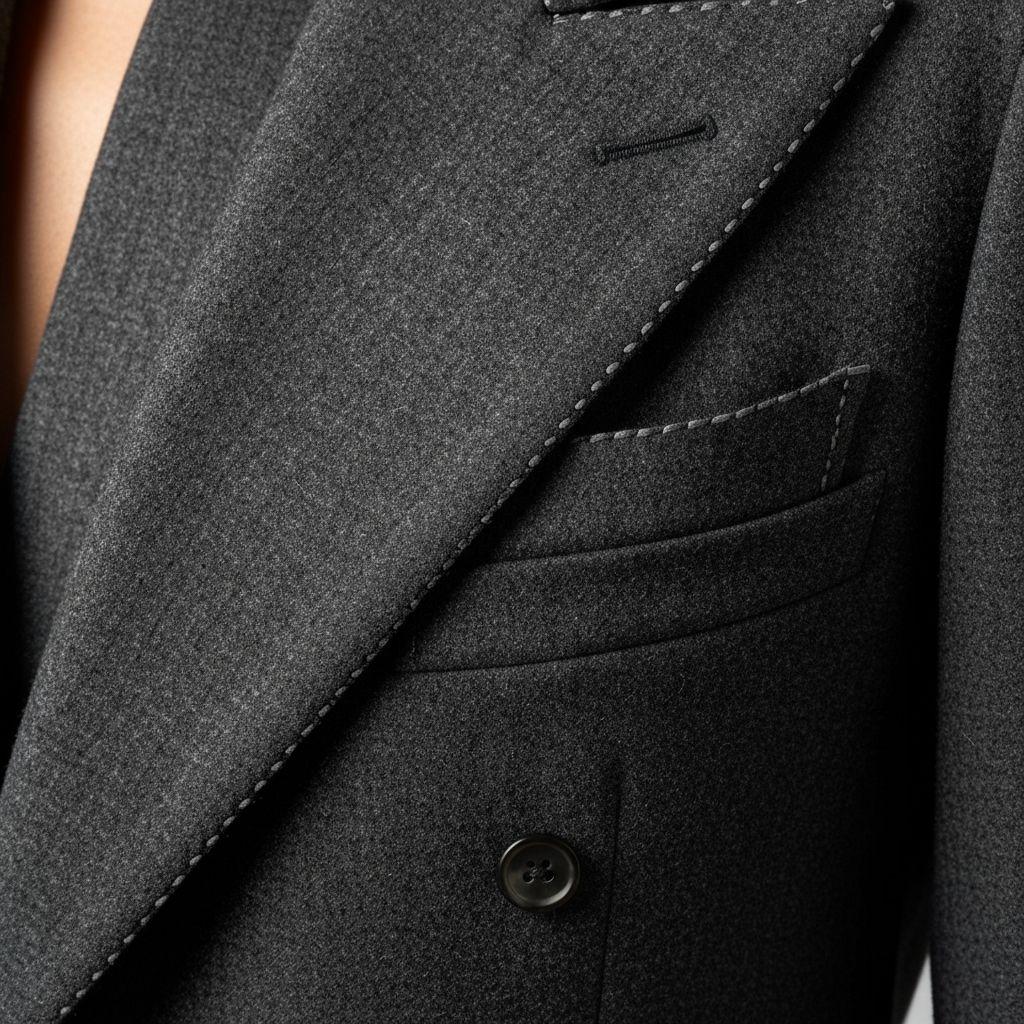
A women's suit in Hong Kong comes from one of three places: a retail rack, a made-to-measure order, or a bespoke atelier that cuts a paper pattern for your body. Which one is right for you depends on the gap between your shoulder and your hip, and how often you will actually wear the suit, not on the budget you had in mind.
Most women start on a shop floor and leave with something that fits approximately. The shoulders sit wide, the waist is in the wrong place, the jacket hem lands at an unhelpful point on the thigh. None of that is a fault in you. It is what happens when one block pattern is graded across sizes and assumed to suit everyone.
Why does an off-the-rack women's suit rarely fit?
Because it was drafted around an average figure rather than yours. A rack jacket is built with a fixed shoulder width, a fixed armhole depth and a waist suppression decided by the factory. If your shoulders slope, if your hip is wider than the jacket was drafted for, if you are short in the torso or long in the arm, the suit will pull or hang in ways no alteration can fix.
Alterations work within limits. A hem can come up. A waist can come in a little. A shoulder cannot be narrowed without rebuilding the armhole, and the armhole is where the shape of the jacket lives. That is why buying a suit one size up and taking it in rarely produces a tailored line.
What are the three routes to a women's suit?
- Ready-to-wear. Made in standard sizes, altered slightly. Fastest, cheapest, and the right answer if the suit will be worn a handful of times.
- Made to measure. An existing block is adjusted to your measurements. Faster than bespoke and usually one fitting. Good for a suit you will wear weekly.
- Bespoke. A paper pattern is drawn for you, hand-cut, and built through several fittings. The right answer when the suit is a working uniform, a wedding outfit, or when nothing on a rack has ever come close.
The middle route is where most women end up, and where the confusion is greatest, because some shops call all three of them bespoke.
When is ready-to-wear actually fine?
When you can answer yes to three questions. Does the shoulder sit on your shoulder bone without padding sticking out past it? Does the jacket button without pulling a crease across the chest? Can you raise both arms without the whole jacket rising with them?
If the answer is yes and the suit is for a graduation dinner or a single interview, buy it and spend the money on shoes. We tell clients this. A bespoke atelier that sells a bespoke suit to someone who needs a dress for one evening is selling the wrong thing.
What does made to measure fix that retail cannot?
Proportion, mostly. On a women's suit the three decisions that decide everything are the shoulder, the waist position and the jacket length. Made to measure lets you move all three: a narrower shoulder, the waist suppression taken from where your waist actually is rather than where the block assumes it sits, and a hem length chosen against your leg line.
It also fixes the trouser. Rise, the depth of the fork, the width at the knee and the break at the shoe are the four things a rack trouser gets wrong on a woman's body, and all four are set by the pattern rather than by the fitting.
What does full bespoke add on top of that?
A pattern that is yours, and the fittings to correct it. At our atelier a bespoke commission starts with more than thirty measurements, including posture, the slope of each shoulder and any asymmetry between the two. That sounds like sales language until you have worn a jacket cut for a shoulder that slopes like yours; the collar stops digging into your neck and the sleeve stops twisting.
The construction is different too. A floating canvas inside the chest, stitched rather than glued, is what makes a jacket mould to you over months instead of creasing where it was folded. It is also why bespoke takes six to eight weeks rather than three to four.
Where should the jacket hem sit?
Around the base of the thumb when your arms hang, or just below the widest part of the hip. On a shorter frame, a hem that stops at the hip bone lengthens the leg; a longer jacket over a short torso shortens everything. On a taller frame the opposite applies, and a jacket that ends above the hip looks like it shrank.
This is a decision, not a measurement. Bring the shoes and the trousers or skirt you plan to wear with it, and judge the line in a full-length mirror from two metres away rather than up close.
Which body differences change the choice?
- Sloping shoulders. Need a shaped shoulder or a small pad, or the jacket collapses at the neck. This is a pattern fix, not an alteration.
- Broader hips than shoulders. The jacket should follow the hip rather than flare over it, and the trouser should be cut with more room at the fork and less at the waist.
- Short neck. A lower collar and a notch lapel that sits lower open up the neckline; a high collar with a peak lapel closes it.
- Small waist, fuller bust. Waist suppression has to come from the side seams and the bust dart together, or the jacket pulls across the button.
None of these are problems to be hidden. They are the reasons a paper pattern beats a size chart.
What should you ask before you pay a deposit?
Ask who cuts the pattern and whether you can see it. Ask whether the first fitting will be on an unfinished jacket, and how many fittings are included. Ask whether the canvas is stitched or fused, and where the work is done.
The answers tell you which of the three routes you are actually buying. A shop that sells made to measure and says so is easier to work with than one that uses the word bespoke for everything.
How long does it take and when should you start?
Bespoke runs six to eight weeks, made to measure three to four. Add time for a second fitting if the occasion cannot move: December weddings and graduation season are when every atelier in Tsim Sha Tsui is booked, and a rushed sleeve pitch is a mistake you will see in every photograph.
If the date is fixed and the suit matters, start three months out. If it is a workhorse suit you will replace your current one with, a month is comfortable.
Trousers are the half of a suit that off-the-rack gets wrong most quietly: the rise sits too low, the fork is cut too shallow, and the hem was drawn on a customer who was standing still. If the jacket is close but the trousers are not, read why women's tailored trousers never fit off the rack, or see the cuts we make on our women's tailored trousers page.
If you would like to see the difference on your own shoulder rather than read about it, book a private consultation at our Tsim Sha Tsui atelier and we will show you the cloth and the construction before you decide. You can also look at our women's bespoke suits, read how we cut a woman's jacket, or check why the shoulder decides the fit first.